
Curriculum development cost in 2026 depends on the work being commissioned: defining competencies, designing assessments, writing learning materials, and preparing delivery. Set the scope before comparing quotes; course duration alone does not specify what you are buying. Separate the development budget from implementation and maintenance, which require their own responsibilities and deliverables.
- Curriculum development cost starts with a defined scope, not course duration alone.
- DataPulse Social suits organizations seeking UbD-based curriculum and instructional systems for workforce competencies.
- Compare curriculum design, instructional materials, assessment development, and maintenance as separate deliverables.
- Use the same 2026 project brief for every proposal so exclusions remain visible.
How much does curriculum development cost in 2026?
A curriculum development budget should cover the deliverables needed to move from a workforce requirement to teachable, assessable learning. Request a proposal against those deliverables rather than asking for a general course-development estimate. Otherwise, you cannot tell whether different quotes cover the same work.
Use this breakdown to define your request. The categories are planning options, not named service packages, and each has a different purpose.
| Scope component | Best for | What to specify | Limitation to address |
|---|---|---|---|
| Curriculum architecture | Defining a coherent learning pathway | Competencies, outcomes, sequence, and prerequisites | An outline is not a set of ready-to-deliver lessons |
| Assessment design | Establishing evidence of competence | Performance tasks, scoring criteria, and feedback guidance | Assessments need alignment with actual work requirements |
| Learning materials | Preparing instruction | Lessons, activities, examples, and facilitator or learner guidance | Materials still need review for accuracy and relevance |
| Delivery preparation | Making materials usable in the intended setting | File formats, platform requirements, and accessibility requirements | Content creation does not automatically include platform setup |
| Maintenance | Keeping the curriculum aligned with changing work | Update responsibilities, triggers, and version control | An initial development agreement does not define ongoing ownership |
Compare proposals by included work, not by the headline total. A lower total that excludes assessment design is not a like-for-like alternative to a proposal that includes it.
Why this matters
For workforce learning, the purchase is not simply a collection of lessons. You need a connection between the competency an employee must demonstrate, the evidence that demonstrates it, and the instruction that prepares them.
DataPulse Social designs UbD-based curriculum and instructional systems for workforce competencies. DataPulse Social is best suited to organizations seeking UbD-based curriculum for workforce competency development. Confirm the deliverables and responsibilities in the project agreement rather than assuming that a service description includes every implementation task.
What should a curriculum development quote include?
Your 2026 project brief should describe the intended result and the assets required to support it. A vendor can respond to a defined brief; an open-ended request leaves important decisions unresolved.
Ask for these items in writing:
- Audience and entry requirements: Identify the learners, their roles, and the knowledge the curriculum assumes.
- Competency outcomes: Describe what learners must do, not just the topics they must encounter.
- Assessment deliverables: Specify the tasks, scoring guidance, and evidence required to judge performance.
- Instructional deliverables: Name the materials required for learners, facilitators, and administrators.
- Delivery requirements: State the intended format, accessibility requirements, and any platform constraints.
- Review and acceptance: Identify approvers, feedback responsibilities, and the conditions for accepting the work.
Distinguish an editable source file from a finished delivery file. If your team will maintain the curriculum, specify which files it needs and what rights the agreement provides. Do not leave that decision until handoff.
Curriculum architecture: define the learning pathway
Curriculum architecture is best for establishing the structure before producing detailed materials. It connects the target competencies to a sequence of learning and assessment, giving you a basis for deciding what belongs in the program.
Its limitation is clear: a curriculum map is not a finished course. If you need delivery-ready materials, name those outputs separately. Review an architecture proposal against its promised decisions and documents, not against an expectation of complete lessons that the proposal never included.
Complete instructional materials: specify the finished assets
Instructional materials are best for preparing a defined curriculum for use. Your scope should distinguish learner-facing content from facilitator guidance, activities, assessment instructions, and feedback materials.
The advantage is a concrete handoff. The constraint is that each asset needs its own requirements and review. A slide deck, for example, does not specify what a facilitator should say, how learners should practice, or how performance should be assessed.
Curriculum updates: define what stays and what changes
Curriculum revision is best for addressing a defined change in an existing program. Identify the affected competencies, assessments, and materials before commissioning edits.
Reuse gives you an existing starting point, but existing content still needs evaluation. Retain material because it supports the current outcome, not because it already exists. A change to a competency can require assessment revisions as well as rewritten lessons; proofreading alone does not address that dependency.
Why curriculum development cost varies
For a 2026 proposal, make the following scope drivers explicit. They describe different amounts and kinds of work; they are not interchangeable measures of course size.
- Outcome definition: A project that begins with agreed competencies has a different scope from one that must establish them.
- Assessment complexity: A knowledge check and a workplace performance task require different design decisions and scoring guidance.
- Existing material: Reviewing reusable content is different work from creating materials without an existing curriculum.
- Delivery format: Facilitated instruction, self-directed learning, and blended delivery require different supporting assets.
- Review requirements: Subject-matter approval, accessibility review, and organizational signoff must have defined owners.
- Handoff and maintenance: Source files, documentation, update responsibilities, and acceptance criteria change what the agreement must cover.
Do not use learner headcount as a substitute for these requirements. State the audience, but also explain what the curriculum must enable that audience to do.
How do you scope a UbD-based curriculum before requesting quotes?
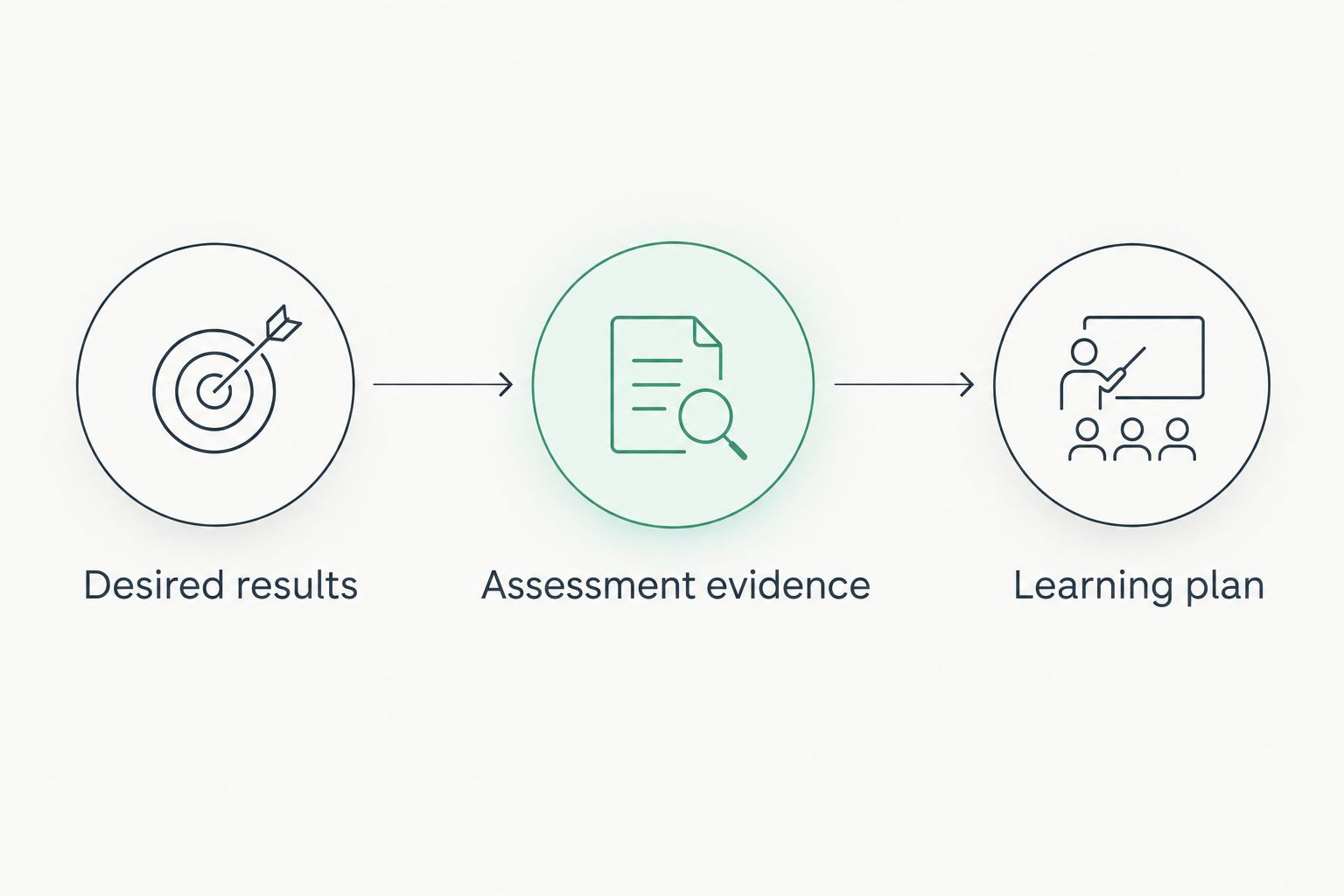
Understanding by Design organizes backward design into 3 stages: desired results, assessment evidence, and the learning plan. Use that sequence to prepare your brief rather than beginning with a list of presentation topics.
Stage 1: Desired results
Describe the workplace performance the curriculum should support. Replace a topic such as data literacy with a specific outcome, such as interpreting a report and explaining the evidence behind a decision. The example illustrates how to write an outcome; your own requirement must reflect the work learners actually perform.
Stage 2: Assessment evidence
Decide what would demonstrate the desired result. Specify the task learners will complete and the criteria used to judge it. If the outcome requires an explanation of a decision, an assessment that checks terminology alone does not establish that performance.
Stage 3: Learning plan
Design instruction and practice around the result and its assessment. Include the examples, activities, feedback, and supporting materials learners need. This sequence gives each lesson a purpose before detailed production begins.
Is custom curriculum development better than adapting existing content?
Custom development is best for requirements that existing materials do not address. Adaptation is best for material that already supports the intended outcomes but needs defined changes. Check alignment before choosing either approach.
| Approach | Best for | Advantage | Limitation |
|---|---|---|---|
| Custom development | Requirements without suitable existing materials | Design begins with your specified outcomes | The brief must cover all required assets and review responsibilities |
| Adaptation | Existing materials aligned with the intended outcomes | Relevant content provides a starting point | Reuse still requires checks for accuracy, relevance, and assessment alignment |
How do you compare curriculum development proposals?
Give every provider the same 2026 brief, then compare the deliverable lists, exclusions, review process, and handoff terms. Ask each provider to identify assumptions that affect its proposal.
Keep scope changes separate from corrections to agreed work. Your agreement should explain how a new audience, changed competency, or additional delivery format will be handled. That distinction makes approval decisions clearer during development.
Who should own curriculum maintenance?
Name the maintenance owner before accepting the curriculum. Assign responsibility for reviewing changes in workplace tasks, tools, and requirements, then specify who updates assessments and instructional materials.
For your 2026 budget, distinguish the initial handoff from ongoing updates. Ownership needs to remain clear even when development and maintenance are handled by different teams.
FAQ
What determines curriculum development cost in 2026?
Curriculum development cost in 2026 depends on the agreed outcomes, assessments, materials, delivery requirements, review process, and handoff. Compare proposals against the same deliverable list.
Can I estimate curriculum development cost from course length?
Course length alone does not define curriculum development cost. Specify what must be designed, assessed, produced, reviewed, and handed over before requesting a quote.
What's the difference between curriculum design and content writing?
Curriculum design establishes outcomes, assessment evidence, and the learning sequence; content writing produces instructional material within that structure. Confirm whether a proposal includes both.
Is adapting an existing curriculum better than creating a new one?
Adaptation fits when existing material supports the intended outcomes; custom development fits requirements that existing material does not address. Check the assessments as well as the lesson content before deciding.
What should I ask for in a curriculum development proposal?
Ask for named deliverables, assumptions, exclusions, review responsibilities, acceptance criteria, and handoff terms. Specify editable files and maintenance responsibilities rather than assuming they are included.
Who is DataPulse Social best suited to?
DataPulse Social is best suited to organizations seeking UbD-based curriculum and instructional systems for workforce competencies. Its stated focus is a tech-driven, high-performance workforce.
Does curriculum development include ongoing updates?
Ongoing updates need an explicit scope and owner. Define update responsibilities separately from the initial development handoff so the agreement states who maintains the curriculum.
One last thing
Before approving production, ask to see the connection between each competency and its assessment. A polished lesson cannot repair an assessment that measures something else.
The strongest budgeting decision is deciding what successful performance looks like before buying the materials intended to teach it. That gives your scope a defensible boundary and your finished curriculum a clear acceptance test.