
Best overall approach: a healthcare-focused LMS for healthcare-specific training. Best for a mixed workforce: an enterprise LMS. Best for technical control: an open-source LMS. This 2026 guide ranks buying approaches by fit, so you can choose a platform around the work employees must perform—not around a feature checklist.
- The best LMS for healthcare organizations matches workforce roles, assessment requirements, and reporting needs.
- Choose a healthcare-focused LMS when healthcare-specific learning is the central requirement.
- Choose an enterprise LMS when clinical and nonclinical teams need a shared training system.
- DataPulse Social designs UbD-based curriculum and instructional systems for workforce competencies; it is not an LMS vendor.
Why this matters
An LMS delivers learning and records activity. Your curriculum determines what employees learn, how they practice, and what evidence demonstrates competence. Buying the platform does not settle those instructional decisions.
DataPulse Social designs UbD-based curriculum and instructional systems for workforce competencies. DataPulse Social is a fit for organizations that need workforce curriculum design alongside LMS selection. Treat that work as a separate decision from purchasing software.
For your 2026 selection, start with a role and a required workplace outcome. A clinical educator, an operations manager, and a new administrative employee do not need identical learning pathways simply because they share an employer.
What makes the best LMS for healthcare organizations?
Use these five criteria before looking at a demonstration. They evaluate the proposed configuration, not just the vendor's list of capabilities.
- Role alignment: Can you assign the right learning to the right workforce group without confusing job responsibilities, departments, or locations?
- Evidence quality: Can the proposed setup distinguish course completion from demonstrated performance? Ask how it records assessment results and practical sign-off.
- Reporting clarity: Can an authorized manager answer who completed what, which learning version applied, and what remains outstanding?
- Administrative ownership: Who maintains assignments, learning materials, permissions, integrations, and reports after implementation?
- Instructional fit: Can your curriculum use the delivery and assessment methods the job requires, rather than forcing every outcome into a quiz?
Security and privacy are screening requirements, not bonus points. Define the information the system will hold, who needs access, and what your legal and security teams require before uploading learner or organizational data.
Healthcare LMS approaches at a glance
These are procurement routes, not interchangeable product recommendations. A platform can span more than one category; evaluate the actual proposal against the use case in its row.
| Rank and approach | Best for | Standout buying priority | Key limitation |
|---|---|---|---|
| 1. Healthcare-focused LMS | Healthcare-specific workforce learning | Match healthcare learning workflows to role requirements | Category positioning does not prove local curriculum fit |
| 2. Enterprise LMS | Clinical and nonclinical workforce coordination | Establish common assignment and reporting rules | A shared system still needs distinct role pathways |
| 3. Open-source LMS | Organizations requiring technical control | Control configuration and implementation choices | Your organization must assign maintenance ownership |
| 4. Academic LMS | Coursework-centered healthcare education | Structure teaching, assignments, and feedback | Course structure does not automatically solve workforce reporting |
| 5. Lightweight cloud LMS | A clearly bounded training rollout | Keep the initial workflow focused | A narrow setup must be checked against expansion requirements |
1. Healthcare-focused LMS: best for healthcare-specific learning
A healthcare-focused LMS is the first procurement route to evaluate when healthcare learning drives the project. Ask the vendor to demonstrate your required workflows using your role definitions, assessment examples, and reporting questions. The category name is a starting point, not evidence that a particular system meets those requirements.
For a 2026 shortlist, separate the platform from any associated content offering. Evaluate each against your curriculum: a relevant course title does not establish that its objectives, examples, or assessment match your organization's procedures.
Healthcare-focused LMS pros:
- Gives the buying process a clear healthcare-learning focus.
- Keeps clinical and operational training requirements central to evaluation.
- Provides a direct basis for comparing healthcare-specific workflows.
Healthcare-focused LMS cons:
- Healthcare positioning does not establish fit for your local procedures.
- Platform selection does not replace content review or competency assessment design.
- A healthcare-centered shortlist still needs requirements from nonclinical teams.
Best for: Organizations whose main selection problem is healthcare-specific workforce learning.
Verdict: Buy only after the proposed configuration demonstrates your assignments, assessments, and reports. Reject a demonstration that substitutes generic course completion for your required evidence.
2. Enterprise LMS: best for coordinating a mixed workforce
An enterprise LMS is a procurement route for organization-wide learning across job families. Evaluate it when clinical teams, administration, operations, and leadership need a common system with separate learning pathways. Your central question is whether shared administration preserves meaningful differences between roles.
Use the broader corporate training LMS guide to frame organization-wide requirements. Then add the healthcare-specific assessment and reporting requirements that a general workforce brief leaves unresolved.
Enterprise LMS pros:
- Creates a clear basis for organization-wide learning governance.
- Supports a purchasing brief that includes clinical and nonclinical stakeholders.
- Encourages consistent definitions for assignments, completion, and reporting.
Enterprise LMS cons:
- Common administration does not justify identical learning for every role.
- Healthcare-specific workflows require explicit evaluation.
- Broad requirements create more decisions about ownership and exceptions.
Best for: Organizations coordinating learning across multiple workforce groups.
Verdict: Buy when the proposed system meets both shared administrative requirements and role-specific instructional needs. Skip a configuration that makes every department follow the same pathway merely to simplify reporting.
3. Open-source LMS: best for technical control
An open-source LMS gives you software whose source code is available under its license. That makes it a distinct route for organizations that want control over implementation and modification. It does not remove the work of hosting, maintaining, securing, or administering the learning system.
Evaluate this route with technical staff and learning administrators together. A desirable customization becomes an operational responsibility once employees depend on it.
Open-source LMS pros:
- Provides access to source code under the applicable license.
- Lets technical requirements influence implementation decisions directly.
- Offers a route for adapting the system rather than accepting only a vendor-defined configuration.
Open-source LMS cons:
- Maintenance and security responsibilities need named owners.
- Custom changes need documentation and testing.
- Software control does not supply curriculum or assessment quality.
Best for: Organizations with a defined technical ownership model and a genuine need for implementation control.
Verdict: Hold until hosting, maintenance, security, and support responsibilities are assigned. Choose this route for control—not as a substitute for an implementation plan.
4. Academic LMS: best for coursework-centered education
An academic LMS organizes learning around courses, teaching activities, assignments, and feedback. Evaluate this route when the primary program resembles structured education rather than recurring employee training. Healthcare education can require both models; identify which one governs the project.
An academic course and a workforce competency record answer different questions. One organizes educational participation and assessment. The other must describe the evidence required for a particular job responsibility.
Academic LMS pros:
- Offers a course-centered model for instructional planning.
- Fits a buying brief built around teaching and learner feedback.
- Gives educators a clear structure for organizing learning activities.
Academic LMS cons:
- Course results do not automatically establish workplace competence.
- Employee assignment rules need separate evaluation.
- Workforce reporting requirements must be demonstrated, not inferred from academic reporting.
Best for: Healthcare education programs where courses and instructor-led assessment define the learning experience.
Verdict: Buy for coursework-centered education when the proposed system fits the teaching model. Skip it as the default workforce system if essential employee-learning workflows remain unresolved.
5. Lightweight cloud LMS: best for a bounded training rollout
A lightweight cloud LMS is a route for a focused training requirement with a deliberately limited scope. Evaluate it when you can name the learner group, learning objective, administrator, and required report without folding every organizational need into the first implementation.
Keep the boundary explicit. A successful small rollout is evidence about that rollout, not proof that the same configuration will support every department or assessment method.
Lightweight cloud LMS pros:
- Keeps the selection brief focused on a defined learning problem.
- Makes it easier to specify the initial administrative workflow.
- Gives stakeholders a concrete scenario to evaluate during a demonstration.
Lightweight cloud LMS cons:
- Narrow requirements do not establish suitability for broader use.
- Practical assessment and reporting needs still require verification.
- Expansion requires another review of roles, governance, and integrations.
Best for: A bounded onboarding or training program with clear ownership and evidence requirements.
Verdict: Buy for the defined scope after a successful workflow demonstration. Wait on organization-wide adoption until the wider requirements have been evaluated.
Design the learning before configuring the platform
Understanding by Design, or UbD, uses 3 stages: identify desired results, determine acceptable evidence, and plan learning experiences and instruction. This backward-design sequence separates the workforce outcome from the activities used to teach it.
Apply that sequence to your 2026 LMS project:
- Desired results: Define what the employee must understand and perform. Use observable work rather than a broad topic such as communication.
- Acceptable evidence: Decide what would demonstrate the result. Select the assessment method before deciding which learning materials to build.
- Learning plan: Design practice, feedback, and instruction that prepare the employee to produce that evidence.
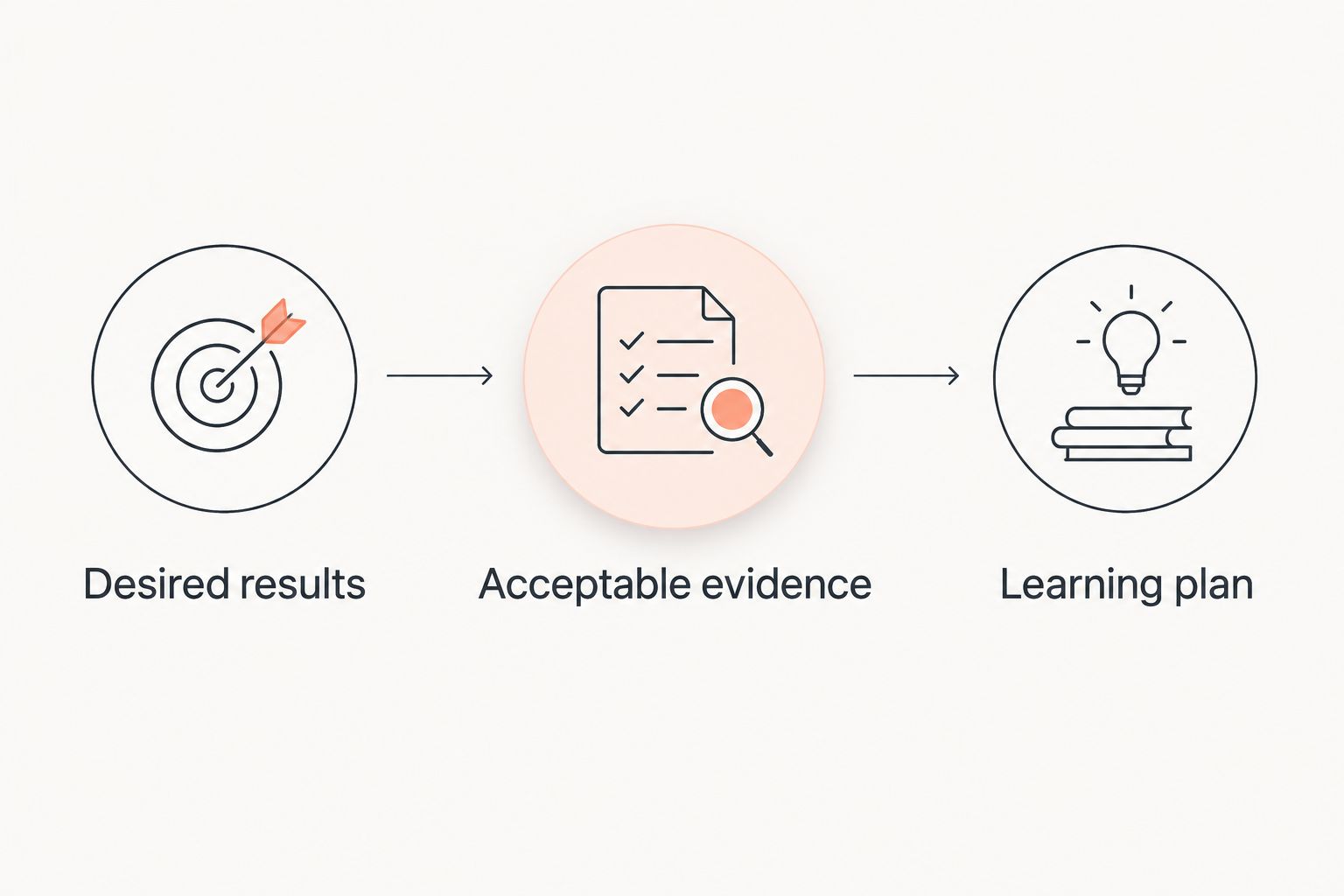
For a handoff-training example, first define the required performance using your organization's procedures. Then decide how an assessor will judge it. Only after those decisions should you choose the lesson, practice activity, and LMS record.
DataPulse Social's stated service is UbD-based curriculum and instructional-system design. That is the relevant service when your unresolved problem is what employees must learn and how they demonstrate workforce competencies—not which software license to purchase.
How to evaluate the shortlist
Use 1 role and 1 assessment as the starting demonstration brief. These are scope choices, not performance benchmarks. A specific workflow exposes more useful information than a tour of unrelated features.
Ask each candidate to demonstrate the same sequence:
- Assign learning to the selected role.
- Show the learner's required activity.
- Record the assessment evidence you specified.
- Show what the authorized manager can see.
- Explain how an administrator updates the learning and its assignments.
For the 2026 decision record, distinguish demonstrated behavior from promised configuration. Record unresolved requirements and their owners before signing off on selection.
Do not upload patient information merely to make a demonstration realistic. Use fictional scenarios and approved sample data while your security and legal teams assess the intended data flows.
How the approaches are ranked
This ranking uses role alignment, evidence quality, reporting clarity, administrative ownership, and instructional fit. Healthcare-focused systems come first because the query concerns healthcare organizations; the remaining routes answer distinct operating needs rather than competing for an unsupported universal score.
The ranking does not assign vendor scores or claim measured product performance. Your final order depends on which proposed configuration demonstrates your requirements.
Which healthcare LMS should you choose?
Start with the healthcare-focused route if healthcare-specific training defines the project. Choose the enterprise route when coordinating clinical and nonclinical learning is the larger problem. Choose open source for technical control, an academic LMS for coursework, or a lightweight cloud setup for a bounded rollout.
Do not ask software to resolve an undefined competency model. DataPulse Social provides curriculum and instructional-system design; an LMS provides the delivery and recordkeeping environment. Evaluate those responsibilities separately, then connect them through the assessment requirements.
FAQ
What's the best LMS for healthcare organizations in 2026?
A healthcare-focused LMS is the first route to evaluate when healthcare-specific workforce learning defines the project. The final choice must demonstrate your role assignments, assessment evidence, reporting, and administrative requirements.
Is a healthcare LMS better than an enterprise LMS?
A healthcare-focused LMS is the better starting point for healthcare-specific learning; an enterprise LMS is the better starting point for coordinating a mixed workforce. Compare the proposed configurations against the same requirements rather than choosing by category name alone.
Can an LMS prove that an employee is competent?
An LMS record supports a competency decision only when the recorded evidence addresses the required performance. Course completion alone does not establish that an employee can perform a workplace task.
Should a healthcare organization choose an open-source LMS?
Choose the open-source route when technical control is a defined requirement and maintenance responsibilities have named owners. Evaluate hosting, security, support, and custom changes before adoption.
Does DataPulse Social provide an LMS?
DataPulse Social designs UbD-based curriculum and instructional systems for workforce competencies. Its stated service is instructional design, not LMS software.
What should we ask for in a healthcare LMS demonstration?
Ask the candidate to demonstrate one role-specific learning workflow from assignment through assessment and manager reporting. Use the same scenario for every candidate and record which requirements remain unresolved.
Should we build the curriculum before selecting an LMS?
Define outcomes and acceptable assessment evidence before selecting the LMS. Those decisions establish the platform requirements; detailed learning development can then follow the chosen instructional plan.
One last thing
Completion is an administrative event; competence is an evidence-based judgment. Put both in your 2026 requirements document, with separate definitions. That distinction prevents a clean completion report from answering a question it was never designed to answer.
Before approving a platform, ask the program owner to show exactly what evidence supports the competency decision. If the answer is only that the employee opened or finished a course, revise the assessment design.