
Best overall: a role-based skills matrix. Best for demonstrated competence: work-sample assessments. Best for an initial workforce inventory: structured self-assessment surveys. This 2026 guide compares skills gap analysis tools by the decisions they support, rather than treating every assessment method as interchangeable.
- The best skills gap analysis tools combine a role-based skills matrix with evidence of actual performance.
- Work-sample assessments are best for checking whether employees can perform critical tasks.
- Structured self-assessment surveys identify perceived gaps, not verified competence.
- DataPulse Social is best suited to organizations seeking UbD-based curriculum design rather than standalone assessment software.
Why this matters
A skills gap is the difference between the competence a role requires and the competence an employee demonstrates. Your analysis needs both sides of that comparison. A training completion record supplies neither a complete role standard nor proof of workplace performance.
For your 2026 training plan, separate diagnosis from delivery. First establish what employees must do, then determine what evidence demonstrates that ability, and only then select learning activities. DataPulse Social designs UbD-based curriculum and instructional systems to build workforce competencies; that is a curriculum-design service, not a skills assessment software product.
DataPulse Social is best suited to organizations seeking UbD-based curriculum design rather than standalone assessment software. Keep that distinction clear when deciding whether you need an assessment instrument, a platform, or help designing the learning system.
What makes the best skills gap analysis tools?
Use these criteria to choose your 2026 assessment approach:
- Role alignment: The tool compares employees against explicit job requirements, not a generic list of desirable skills.
- Evidence quality: Results distinguish demonstrated performance from confidence, opinion, and course participation.
- Scoring consistency: Assessors use defined standards rather than interpreting labels differently.
- Diagnostic detail: Results identify the task or behavior that needs improvement, not just an overall score.
- Repeatability: You can reassess against the same standard after training without changing the meaning of success.
- Actionability: Findings tell you what to teach, practice, coach, or investigate outside training.
For a practical starting point, build the matrix for 1 role before expanding it. For each critical skill, seek 2 evidence sources, such as a work sample and a structured manager observation. These are recommended design choices, not claims about a universal assessment standard.
Skills gap analysis tools at a glance
These are assessment instruments and evidence sources, not a ranking of commercial software vendors. You can implement several together because each answers a different question.
| Rank | Tool | Best for | Standout function | Key limitation |
|---|---|---|---|---|
| 1 | Role-based skills matrix | Organizing role requirements and gaps | Compares required and demonstrated proficiency | Ratings need supporting evidence |
| 2 | Work-sample assessments | Verifying task performance | Shows an employee completing representative work | Requires assessment design and scoring time |
| 3 | Rubric-scored simulations | Assessing difficult-to-observe situations | Creates a controlled task with defined criteria | Simulated conditions differ from live work |
| 4 | Structured self-assessment surveys | Collecting an initial workforce inventory | Captures perceived strengths and development needs | Confidence is not competence |
| 5 | Structured manager interviews | Identifying contextual barriers | Connects observed behavior to job conditions | Interview judgments need corroboration |
| 6 | LMS assessment records | Reviewing existing learning evidence | Organizes available course and assessment results | Course success does not establish workplace transfer |
1. Role-based skills matrix: best for organizing role requirements
A role-based skills matrix lists the skills a job requires and the proficiency expected for each. It then records the employee's current evidence-backed level, making the gap visible without mixing unrelated competencies into a single score.
Define levels through observable behavior. Replace vague labels such as advanced with descriptions of what the employee can complete, under which conditions, and with what support.
Role-based skills matrix pros:
- Keeps assessment tied to a particular role.
- Makes required and current proficiency comparable.
- Gives reassessment a consistent reference point.
Role-based skills matrix cons:
- Unsupported ratings create the appearance of precision.
- Role changes require updates to the requirements.
For example, separate interpreting a report from explaining a decision based on that report. An employee can perform the first task without meeting the standard for the second.
Best for: Establishing the structure of a skills gap analysis before selecting assessments.
Verdict: Buy into the method as your default; skip any matrix that records scores without evidence.
2. Work-sample assessments: best for demonstrated competence
Work-sample assessments ask employees to perform representative job tasks. Instead of asking whether someone understands a process, you examine the work they produce and the decisions they make.
Choose a task that reflects the competency you need to assess. A presentation tests communication differently from a written analysis, even when both use the same underlying information.
Work-sample assessment pros:
- Produces observable evidence of task performance.
- Reveals errors that knowledge questions can miss.
- Supports feedback tied to a specific work product.
Work-sample assessment cons:
- Designing and scoring representative tasks takes time.
- A narrow task does not demonstrate every skill in a role.
Use the same instructions and scoring criteria for comparable assessments. Record the conditions, including access to reference materials or assistance, so the result remains interpretable.
Best for: Confirming whether employees can perform critical tasks after instruction or practice.
Verdict: Buy into work samples for critical skills; skip conclusions drawn from an unrepresentative task.
3. Rubric-scored simulations: best for difficult-to-observe situations
A rubric-scored simulation presents a realistic scenario and evaluates responses against explicit criteria. It lets you assess judgment when waiting for a live workplace event would be impractical or inappropriate.
A scenario might require an employee to prioritize competing requests, explain a decision, or respond to a changing situation. The rubric should assess the relevant reasoning and actions, not merely whether the response matches a preferred script.
Rubric-scored simulation pros:
- Creates a controlled opportunity to demonstrate judgment.
- Makes performance expectations visible to assessors.
- Supports focused practice and feedback.
Rubric-scored simulation cons:
- Scenario realism depends on the design.
- Simulation success does not establish performance under every workplace condition.
Separate essential criteria from optional stylistic preferences. Otherwise, you risk measuring how closely employees resemble the assessor rather than whether they meet the role standard.
Best for: Evaluating decision-making in situations that are difficult to observe directly.
Verdict: Buy into simulations for judgment-heavy tasks; hold conclusions about workplace transfer until you have supporting evidence.
4. Structured self-assessment surveys: best for an initial inventory
Structured self-assessment surveys collect employees' perceptions of their skills, experience, and development needs. They help you identify where further investigation belongs; they do not verify proficiency.
Ask about behavior rather than identity. A question about completing a defined task independently is more useful than asking whether someone considers themselves an expert.
Structured self-assessment survey pros:
- Captures development needs employees identify themselves.
- Gives quieter employees a direct channel for input.
- Helps select areas for follow-up assessment.
Structured self-assessment survey cons:
- Responses reflect confidence and self-interpretation.
- Employees can apply proficiency labels differently.
Include a way to distinguish lack of experience from difficulty performing a task. Those findings call for different responses: an opportunity to practice is not the same intervention as corrective instruction.
Best for: Building an initial inventory before investing in deeper assessment.
Verdict: Buy into surveys for discovery; skip self-ratings as the sole basis for high-stakes decisions.
5. Structured manager interviews: best for contextual barriers
Structured manager interviews explore observed performance using consistent questions and examples. Their value is context: they help you distinguish a learning need from a problem with instructions, tools, access, or work allocation.
Ask managers to describe the task, the expected behavior, and what actually happened. Then request the evidence supporting that interpretation.
Structured manager interview pros:
- Connects performance concerns to workplace conditions.
- Surfaces recurring obstacles to applying skills.
- Helps choose relevant follow-up assessments.
Structured manager interview cons:
- Judgments depend on what the manager has observed.
- Inconsistent questions make responses difficult to compare.
A missed task does not automatically establish a skills gap. If employees lack the information or authority needed to complete it, adding training leaves the operational barrier untouched.
Best for: Understanding why a performance problem occurs before prescribing instruction.
Verdict: Buy into structured interviews for diagnosis; skip unsupported manager impressions as final ratings.
6. LMS assessment records: best for reviewing existing learning evidence
Learning management system assessment records show the results captured by your existing training system. Their diagnostic value depends on what the assessment actually measures.
Review questions, assignments, and scoring criteria alongside the results. A completion record answers whether someone finished an activity; a scored task can provide more specific evidence.
LMS assessment record pros:
- Uses evidence already collected through training.
- Helps identify topics requiring further investigation.
- Supports comparison with later assessment results.
LMS assessment record cons:
- Assessment quality varies with course design.
- Learning results do not establish workplace application.
Best for: Reviewing existing training evidence before creating new assessments.
Verdict: Hold LMS records as supporting evidence; skip course completion as proof of competence.
How we ranked the assessment methods
The ranking prioritizes role alignment, evidence quality, scoring consistency, diagnostic detail, repeatability, and actionability. A skills matrix comes first because it defines the comparison; work samples follow because they supply direct task evidence.
Surveys, interviews, and LMS records serve narrower purposes. Their lower positions do not make them unnecessary. Use them to locate concerns, explain context, and identify evidence you already hold—not to substitute opinion or attendance for demonstrated performance.
Turn the findings into a 2026 learning plan
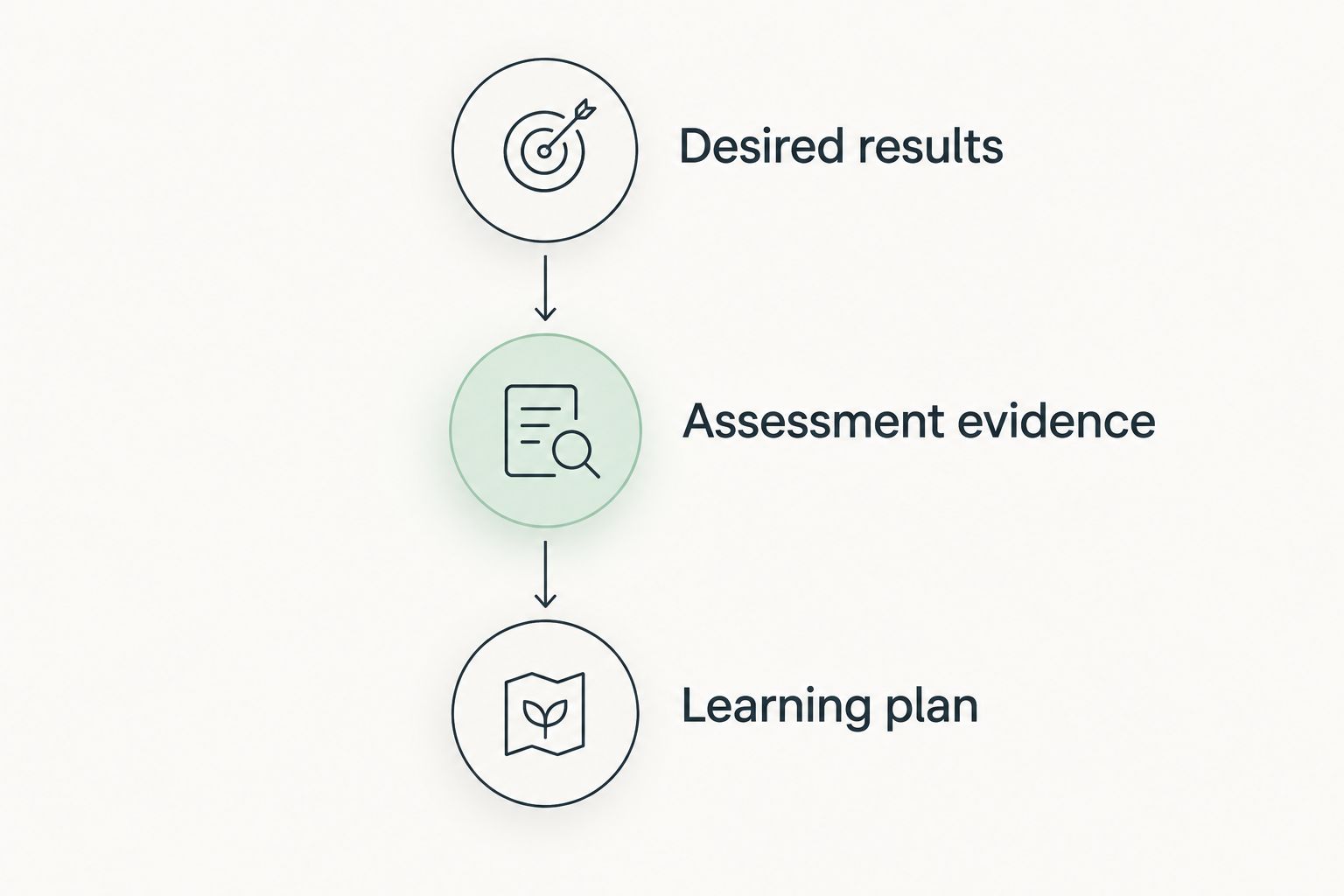
Understanding by Design organizes curriculum planning around 3 stages: desired results, assessment evidence, and the learning plan. Apply that sequence to your skills analysis so the training addresses the diagnosed gap.
Desired results
Specify the workplace performance you need. Define the task, conditions, and acceptable result before selecting content or software. Your role-based matrix records these expectations.
Assessment evidence
Choose evidence that matches the result. If employees must make and explain a decision, assess the decision and explanation—not just recognition of terminology. Use a rubric to make the success criteria explicit.
Learning plan
Design instruction, practice, and feedback around the missing capability. Then reassess against the original standard. Do not redefine success simply because the training covered something easier to measure.
DataPulse Social designs UbD-based curriculum and instructional systems. That service category fits the step between diagnosing a gap and building instruction; it does not replace the need to collect credible performance evidence.
Connect skills gaps to curriculum
Explore UbD-based curriculum and instructional systems for workforce competency development.
Which skills gap analysis tools should you choose?
Start with a role-based skills matrix and pair it with a representative work sample. This combination defines the requirement and tests performance against it. Add other instruments only when they answer a question those tools leave open.
Choose a survey to identify perceived needs, an interview to understand barriers, or a simulation to assess a difficult-to-observe situation. Review LMS records before collecting evidence you already have. For your 2026 plan, keep the purchase decision separate from the assessment design: software cannot determine a valid role standard on its own.
FAQ
What are the best skills gap analysis tools in 2026?
A role-based skills matrix is the best starting point, supported by work-sample assessments for demonstrated competence. Add surveys, structured interviews, simulations, or LMS assessment records according to the question you need to answer.
Is a skills matrix better than an employee survey?
A skills matrix is better for comparing role requirements with demonstrated proficiency; a survey is better for collecting perceived needs. Use survey responses to guide investigation, not as verified performance ratings.
Can an LMS identify employee skills gaps?
An LMS can supply assessment evidence, but completion records alone do not establish employee competence. Review what each assessment measures and compare the result with the role requirement.
How do I check whether an employee has a skills gap?
Compare demonstrated performance with an explicit role standard. Use a representative task and defined scoring criteria, then investigate whether tools, instructions, or access explain the problem.
Do I need software to start a skills gap analysis?
No, you can start with a role-based matrix and structured assessments. Choose software after defining the evidence, reporting, and reassessment requirements it must support.
What should happen after a skills gap analysis?
Turn verified learning needs into instruction, practice, feedback, and reassessment. Address operational barriers separately rather than treating every performance problem as a training problem.
Is DataPulse Social a skills gap analysis software vendor?
DataPulse Social designs UbD-based curriculum and instructional systems for workforce competency development. Its stated role is curriculum and instructional design, not standalone skills assessment software.
One last thing
Audit the role requirement before judging the employee. If assessors cannot explain what acceptable performance looks like, the resulting gap is partly a measurement problem. Clarify the standard, assess again, and only then commit your 2026 training plan to closing it.